
Boiler Service and Maintenance Tips
We have put together some helpful boiler service tips to keep your boiler up and running smoothly.
Maintenance is the single most important thing you can do to increase the life of your boiler.
If you are having trouble with your boiler, please check out our Boiler Service page.
Proper Sizing of Boiler Feedwater System

Since water is the key ingredient used in a boiler system, it is important to understand just exactly what is in the water you will be using. We recommend that customers have a water analysis performed so they have a true picture of what they are dealing with.
One of items that will be quantified in the analysis is the hardness. This is really the amount of mineral contamination that is found in your water. This degree of contamination can be measured by either a chemical analysis or by measuring the water’s ability to conduct (or resist) an electrical current.
Hardness can be reported in one of three different expressions:
- Mg/l – milligrams per liter
- Ppm – parts per million
- Gpg – grains per gallon
We normally work with the grains per gallon expression as it is the easiest for all to understand. Imagine if you took a pill that weighed 8 grains and dissolved it in 1 gallon of pure water. The result would be 8 grains per gallon. Simple and easy to understand, however, other like to express water hardness as mg/l or ppm. Here is a table that can help you make the conversion:
- Gpg X 17.1 = ppm
- Gpg X 17.1 = mg/l
- Ppm X .05833 = gpg
- Mg/l divided by 17.1 = gpg
Water hardness becomes an issue as soon as heat is applied in the boiler system. The most common problem is that of scale formation, a problem that will rob your system of the efficiency it was designed to deliver.
The following formula demonstrates scale formation.

To protect your boiler system, invest in an ion exchange water softener.
Boilers come in many different sizes, shapes and designs.
This creates quite a challenge for those of us that do not purchase boilers on a regular basis. The choice between a firetube design and a water tube design can become very confusing for novice boiler buyers. We thought a quick discussion on the advantages and disadvantages of these boiler designs might prove helpful.

FIRETUBE BOILERS
The Hurst LPE “Performance” boiler is America’s most heavily designed and built boiler in its class.
A welded steel firetube boiler, the LPE has extra heavy 12 gauge tubes for extended life. All tubes are attached to the tube sheets by rolling and flaring. There are no welded tubes in the LPE.
Thickest materials used in the industry…
- Boiler shell is 5/16″ thick boiler plate.
- Twin boiler tube sheets are 1/2″ thick boiler plate.
- Insulation is 2″ mineral wool and is lagged with 22 gauge boiler jacket.
- Extra heavy 3″ channel iron boiler skids.
Designed to last with special industrial grade features…
- Couplings are 3,000 psi.
- Flanged, detachable front and rear smoke boxes.
So What is a Firetube Boiler?
The name firetube is very descriptive. The fire, or hot flue gases from the burner, is channeled through tubes that are surrounded by the fluid to be heated. The body of the boiler is the pressure vessel and contains the fluid. In most cases this fluid is water that will be circulated for heating purposes or converted to steam for process use.
Every set of tubes that the flue gas travels through, before it makes a turn, is considered a “pass”. So a three-pass boiler will have three sets of tubes with the stack outlet located on the rear of the boiler. A 4-pass will have four sets and the stack outlet at the front.
Firetube Boilers are:
- Relatively inexpensive
- Easy to clean
- Compact in size
- Available in sizes from 600,000 btu/hr to 50,000,000 btu/hr
- Easy to replace tubes
- Well suited for space heating and industrial process applications
Disadvantages of Firetube Boilers include:
- Not suitable for high pressure applications 250 psig and above
- Limitation for high capacity steam generation
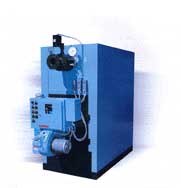
WATERTUBE BOILERS
Unilux Series “Z” Water Boilers:
Provide 85% efficiency to your customers! The unilux series “Z” boilers are available from 20 BHP to 1500 BHP as cataloged standard with larger sizes available by request. This unique, modern forced draft design is the ultimate in water boiler technology. Available as factory packaged or field erect (FE). 20 year warranty on vessel as standard.
What is a Watertube?
A Watertube design is the exact opposite of a fire tube. Here the water flows through the tubes and are incased in a furnace in which the burner fires into. These tubes are connected to a steam drum and a mud drum. The water is heated and steam is produced in the upper drum. Large steam users are better suited for the Water tube design. The industrial watertube boiler typically produces steam or hot water primarily for industrial process applications, and is used less frequently for heating applications.
Watertube Boilers are:
- Available in sizes that are far greater than the firetube design. Up to several million pounds per hour of steam.
- Able to handle higher pressures up to 5,000 psig
- Recover faster than their firetube cousin
- Have the ability to reach very high temperatures
Disadvantages of the Watertube design include:
- High initial capital cost
- Cleaning is more difficult due to the design
- No commonality between tubes
- Physical size may be an issue
Refer to the following table for recommended boiler water quality for Total Dissolved Solids (TDS), Alkalinity and Hardness.
Proper Feedwater Treatment is an absolute necessity!
Unless your boiler receives water of proper quality, the boiler’s life will be needlessly shortened. A steam plant’s water supply may originate from rivers, ponds, under ground wells, etc. Each water supply source requires a specific analysis. Depending upon this analysis, various pretreatment methods may be employed to prepare makeup water for your boiler feedwater system.

General Information on Water Treatment
Suspended solids represent the undissolved matter in water, including dirt, silt, biological growth, vegetation, and insoluble organic matter.
When minerals dissolve in water, ions are formed. The sum of all minerals or ions in the water in the Total Dissolved Solids (TDS).
Iron can be soluble or insoluble. Insoluble iron can clog valves and strainers and can cause excessive sludge build up in low lying areas of a water system. It also leads to boiler deposits that can cause tube failure. Soluble iron can interfere in many processes, such as printing or the dying of cloth. In domestic water systems, porcelain fixtures can be stained by as little as 0.25 ppm of iron.
Water Hardness is the measure of calcium and magnesium content as calcium carbonate equivalents. Water Hardness is the primary source of scale in boiler equipment.
Silica in boiler feedwater can also cause hard dense scale with a high resistance to heat transfer.
Alkalinity is a measure of the capacity of water to neutralize strong acid. In natural waters, the capacity is attributable to bases, such as bicarbonates, carbonates, and hydroxides; as well as silicates, borates, ammonia, phosphates, and organic bases. These bases, especially bicarbonates and carbonates, break down to form carbon dioxide in steam, which is a major factor in the corrosion of condensate lines. Alkalinity also contributes to foaming and carryover in boilers.
There are some basic pieces of boiler room support equipment that should be considered for a complete boiler installation. This equipment is designed to protect your boiler from harmful water conditions.
Here are some of the basic pieces and the functions they serve:
 CHEMICAL FEED SYSTEM
A chemical feed system is used to “feed” the appropriate amount of chemicals into your system to combat scaling and corrosion. A chemical feed system is comprised of a tank, stand, pump, motor and agitator. The feed system is wired so that it will operate in unison with the boiler feed water system or deaerator. This ensures that the proper amounts of chemicals are being fed on a consistent basis.
WATER SOFTENER SYSTEM
A water softener is used to remove hardness from the boiler make-up water. They are available in a wide range of sizes and configurations. By removing hardness in the water you will protect your boiler from the formation of scale that can rob your boiler of its ability to transfer heat efficiently.
BLOW DOWN SYSTEMS
There are two types of blow down systems. A surface blow down/heat recovery and bottom blow down system. A Bottom Blow Down System is used to forcibly remove sludge and sediment from the bottom of your boiler. This is an intermittent process and is dependent upon the boiler operator to perform. It consists of a tank, stand and aftercooler assembly that is used to temper the water before it is sent to the drain. A surface Blow Down System continually removes dissolved solids from the top level of the boiler water and recovers a great deal of the heat which is then returned used to pre-heat boiler feed water.
DEAERATORS
Deaerators are used to remove non-condensable gases from boiler feed water. This is done by heating and aggressively agitating the incoming make-up water. This process reduces the oxygen content of the water to .005 cc/liter and protects your boiler from oxygen pitting and corrosion.
FEEDWATER SYSTEMS
A feedwater system is used to store and return preconditioned make-up water and hot condensate into your boiler. A feedwater system includes a tank, pumps and a stand. Some Feedwater systems include a steam sparge tube, which is used to pre-heat make-up water. This helps to eliminate some of the oxygen in the make-up water.
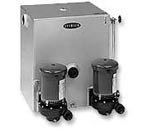 CONDENSATE RETURN UNITS
A condensate return unit is used to reclaim used treated condensate to be used again in your boiler. Not only will you reclaim the water but also the chemicals that were used to treat the water. The result is a significant savings in make-up and the associated chemicals. A Condensate return unit consists of a small tank with small pumps that are used to feed into the boiler.
When people think of a stack system they typically picture a gravity type design; a masonry stack that relays on natural draft to vent the flue gasses. This design is very common in older installations and has been used for centuries. The gravity stack has performed well with the antiquated boiler burner designs of the past but leaves a lot to be desired for today’s high efficiency systems.

Boiler room venting should accommodate:
- Modulating or modular boiler systems with variable heat outputs.
- Long horizontal vents with inadequate rise or capacity.
- Excessive number of turns that create high-pressure loss and inadequate flow.
- Inadequate capacity due to space limitations or the connection of additional equipment to existing systems.
- The need for greater draft or flow than a low-height chimney can provide.
- Erratic or inadequate venting caused by wind, adverse internal pressures, restricted air supply, or indoor/outdoor temperature differences.
- Installation of high efficiency boiler systems to existing chimney system, resulting in the lack of draft and condensation due to lower flue gas temperatures.
The rudimentary mechanical draft assist is a single speed fan that delivers a pre-set volume of air and utilizes a barometric damper for relief should the mechanical draft become too strong. Their design makes them rather inefficient and limits their application to certain types of chimney designs.
Today’s constant pressure chimney automation systems have the ability to control, monitor and maintain pre-set draft requirements by varying the flow. By controlling the draft completely, we can reduce the need for combustion air and can apply the system to virtually any stack design.
EXHAUSTO’s Chimney Automation System (CASV) is for installation and use with multiple and/or modulating boilers and water heaters. It can be used in conjunction with almost any type of appliance and fuel, whether it is forced draft, atmospheric or condensing design.
The Chimney Automation System maintains a perfect, constant draft for the appliances by modulating the chimney fan capacity. The system is activated when there is a call for heat. It will create and maintain a pre-set draft prior to or immediately after the appliance fires.
The system monitors the draft condition at any time and has an integrated safety function. Should the draft fall more than 40% below the set point for more than 12 seconds, it will deactivate the appliances to prevent a potentially hazardous situation.
Advantages to using a chimney automation system:
- Improved Aesthetics – A chimney automation system can improve the look of a building by hiding the stack. Tall stacks are no longer required allowing for terminations at the roof level.
- Cost Savings – the overall cost of an installation can be reduced. The stack will not need to be as tall or the diameter as wide compared to conventional gravity venting. In many cases sidewall venting can be utilized as well.
- Improved Safety – the risk of carbon monoxide spillage is eliminated with the use of a chimney automation system. In fact the Exhausto system includes a spillage-warning device as a standard feature.
- Design Freedom – no longer are designers limited as to how the venting system is to be incorporated into their plan. The use of the automated chimney system ensures proper draft and because it is an engineered system it meets with code requirements for the gravity system.
- Operational Savings – By controlling the draft across all operating conditions, boilers will operate at peak efficiency and provide a significant saving for the owner.
To learn more about Exhausto automated chimney systems please send us an email.
- Be aware – the improper installation or maintenance of boiler gage glasses or site glasses can result in serious bodily injury due to glass breakage.
- Always wear safety glasses when installing, maintaining or observing your boiler gage glass.
- Protect your gage glass from impact, scratches and any other surface damage or serve temperature changes that can weaken the glass.
To ensure your safety and avoid breakage, please review the following DO’S and DO NOT’S:

| DO NOT DO THIS | DO THIS |
| DO NOT reuse any tubular glass, packing or seal.
DO NOT exceed the glass or gage manufacturer’s recommended working pressures or maximum recommended gage glass length. DO NOT bump, impact or scratch the glass. DO NOT tighten gland nut and packing beyond gage manufacturer’s recommendations. DO NOT operate gages unless gage valve sets are equipped with drain vent safety ball check. DO NOT attempt to clean glass while the unit is in operation. Cleaning should be done without removing the gage glass. DO NOT attempt to inspect the glass, to adjust tie rods, packing nuts, or glands to inspect or tighten fittings without isolating the gage from the pressure vessel and opening the drain vent. DO NOT weld, impact or sandblast in the gage glass are without protecting the glass. DO NOT have glass-to-metal contact. DO NOT subject gage glass to bending or twisting stresses. DO NOT allow the gage glass to contact the bottom of the packing gland. |
DO inspect the gage glass daily, keep maintenance records, and conduct routine replacements.
DO install protective guards when necessary to protect personnel. DO protect the outside of the gage glass from sudden temperature changes, such as drafts, water spray, etc. DO remove all deposits fro the seal areas, the gland nuts, glands (where used) and use new packing before installing a tubular gage glass. DO examine gage glass for damage and seals for hard deposits and tears. DO verify that the tubular gage glass, gland, nuts packing, etc. are the correct size and type before installing. DO ensure that the system is protected by a safety shut-off valve system (e.g. safety ball check) |
MAINTENANCE
Maintenance should only be undertaken by qualified, experienced personnel who are familiar with this equipment and have read and understand the instructions.
CLEANING
Keep gage glass clean using nonabrasive commercial glass cleaners. ever use wire brushes, metal scrapers or harsh abrasives which could scratch the glass.
INSPECTION
Maintenance personnel should examine the gage glass for scratches, corrosion, chips, surface flaws or nicks on the surfaces or edges which weaken the gage glass. To examine the glass for these, shine a very bright concentrated light at about a 45 degree angle. Anything which glistens and catches the fingernail or any star-shaped or crescent shaped mark which glistens is cause for replacement. Gage glass which appears cloudy or roughened and will not respond to cleaning procedures is cause for replacement.

